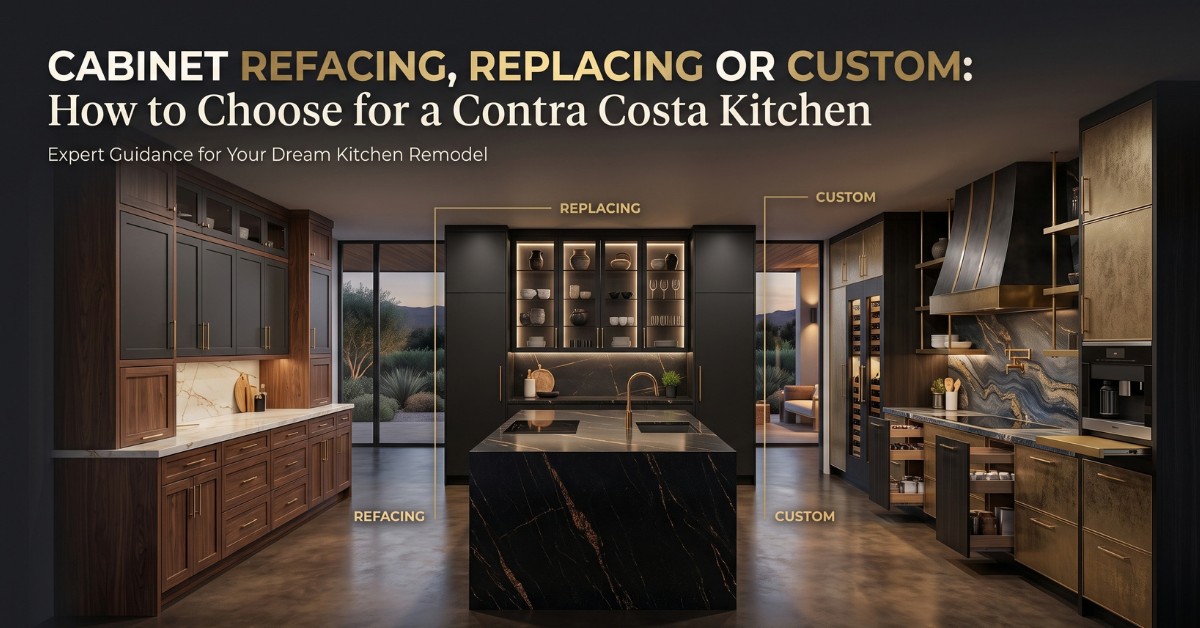
| Quick Answer
In most Contra Costa kitchens the decision comes down to the boxes, not the doors. If the cabinet carcasses are square, dry and solid, and the layout already works for how you cook, refacing gives you most of the result for a fraction of the cost. If the boxes are damaged or the layout is wrong, you are paying twice to keep them. |
The three routes, and what each one actually means
These words get used loosely, including by people selling them, so it is worth being precise before comparing anything.
| Route | What is kept | What is replaced | Typical disruption |
|---|---|---|---|
| Refacing | The cabinet boxes, the layout, the interior shelving | Doors, drawer fronts, hinges, handles, and a veneer or laminate skin on the visible box edges | 3 to 5 days, kitchen largely usable throughout |
| Replacing with semi-custom | Nothing of the old cabinetry. The general layout usually stays | All boxes, doors, drawers and hardware, in standard sizes with a wide finish range | 2 to 4 weeks within a wider remodel |
| Replacing with full custom | Nothing | Everything, built to your exact dimensions rather than to standard increments | 3 to 6 weeks on site, plus a longer lead time before it arrives |
There is a fourth option people forget: a partial replacement. Keeping the perimeter run and rebuilding only the island, or replacing only a damaged section near the sink. It is unglamorous and it is often the right answer in a kitchen that is mostly fine.
The checks that decide it, and you can do them yourself
Open a cabinet door and spend five minutes doing the following. This is genuinely how we assess it on a site visit.
- Press a thumb into the bottom panel of the sink cabinet. This is where water damage shows first. If it gives, flexes or shows swelling at the edges, the box is compromised and you are refacing a failure.
- Look at the carcass sides. Solid plywood or a dense engineered board holds hardware and survives a reface. Thin particleboard with a printed finish often does not, because the screws for new hinges go into material that will not hold them.
- Check the boxes are square. Open two adjacent doors and look at the gap between them top and bottom. A gap that tapers means the box has racked, and new doors will hang the same way the old ones did.
- Test the shelf supports and drawer runners. Drawers that bind, sag or drop at full extension are a box problem, not a front problem.
- Look for swelling at the toe kick and around the dishwasher. Both are chronic leak points and both tell you about the whole run.
- Then ignore all of that for a moment and ask whether the layout works. This is the question that overrules the others.
The layout question is the one that actually matters
Condition tells you whether you can reface. Layout tells you whether you should.
If you are forever walking around the island to get from the sink to the hob, if the fridge door opens into the only path through the room, if the bin is nowhere near the prep area, or if two people cannot be in the kitchen at once without a negotiation none of that is fixed by new doors. Refacing a layout that frustrates you daily preserves the frustration in a nicer finish, and people regret it within a year.
The honest rule: reface when the kitchen works and looks tired. Replace when the kitchen looks fine and does not work.
What refacing does not fix
- A soffit you want gone. If the plan is cabinets to the ceiling, the boxes have to change height, which means replacement. Our separate guide on kitchen soffits covers what is usually inside one and how to find out before you commit.
- Cabinet sizes that are wrong for how you cook. You cannot turn a run of narrow doors into deep pan drawers by refacing. Drawer conversion kits exist for some boxes, but they are a partial answer at best.
- Anything behind the cabinets. Older Contra Costa homes frequently hide undersized electrical, galvanised supply lines and no insulation on exterior walls. Refacing leaves all of it where it is. If you were planning to bring the kitchen up to current code, you will be opening those walls anyway.
- A damp problem. If the sink base is wet, something is leaking. Fix the leak, find out how far the damage runs, and then decide about cabinets.
Where the money goes, and how to get a figure
Cabinetry is routinely the largest single line in a kitchen budget, which is why this decision moves the total more than almost any other. Rather than publishing a figure that will be out of date by spring, we built a cost estimator that does the arithmetic properly.
It asks what you are building, how big it is, which of three finish levels you want Essential, Signature or Bespoke and what else is true about the job. For a 200 square foot kitchen at Signature finish, which means custom cabinetry, stone and designed lighting, it returns a planning range of roughly $650 to $900 per square foot, all in. That spread is about thirty-eight percent and it is wide deliberately. Anyone who narrows it before seeing your house is guessing, and a guess that lands low is the most expensive thing in this business.
It takes about thirty seconds, there is no email gate, and nobody calls you afterwards.
What a planning range includes, and what it cannot know yet
Worth understanding before you compare any two numbers from any two companies.
| A range like that assumes | What it cannot know yet |
|---|---|
| Demolition, haul-off and dump fees | What is actually behind your walls |
| Permits and plan check fees for one jurisdiction | Whether your panel carries the new load |
| Electrical and plumbing brought to current code | Soil, drainage and existing foundation condition |
| Materials at the finish level you selected | The specific products you end up choosing |
| Project management, supervision and final clean | Your jurisdiction’s current plan check queue |
We do not use allowances. An allowance is a placeholder for a decision nobody has made yet, and the gap gets filled in later at your expense. A range is a planning tool; a price is a document, and the difference between the two is a real takeoff that runs past 286 line items before we sign our name to the bottom of it.
The sequence that avoids the expensive mistake
One ordering point, because it catches people out every time. The cabinet decision has to be made before anything is ordered and ideally before anything is demolished because cabinet heights, filler pieces, the hood surround and the countertop support are all specified around it.
The common and costly version goes: order cabinets to ceiling height, start demolition, discover a duct in the soffit, and now the order is wrong. Inspect first, decide second, order third.
Frequently asked questions
Is cabinet refacing worth it?
Yes, when the boxes are sound and the layout already works. It gives you most of the visual result for a fraction of the cost and a fraction of the disruption. It is not worth it when the boxes are damaged, the sizes are wrong for how you cook, or you are changing the layout anyway.
How do I know if my cabinet boxes are good enough to reface?
Press the bottom panel of the sink cabinet for softness, check the carcass sides are solid plywood rather than thin particleboard, look at whether adjacent doors hang square, and test the drawer runners at full extension. Five minutes with a torch tells you most of it.
What is the difference between semi-custom and full custom cabinets?
Semi-custom comes in standard size increments with a wide range of finishes and is where most full remodels land. Full custom is built to your exact dimensions, which matters in older Contra Costa homes where very little is square, and carries a longer lead time.
Will new cabinets fix my kitchen layout?
Only if you move them. New boxes in the same positions give you the same kitchen in a better finish. If the layout frustrates you now, say so at the design stage rather than after the order is placed.
How much does a cabinet remodel cost?
It depends far more on scope and finish level than on the number of doors. Our cost estimator will give you a planning range in about thirty seconds based on project type, size, finish level and the specific complications in your job.
Can I reface cabinets and change the countertops at the same time?
Yes, and it is usually the sensible pairing the countertop comes off for the reface anyway in most cases. Note that a heavier slab may need additional cabinet support, which is a decision to make before the template is taken.